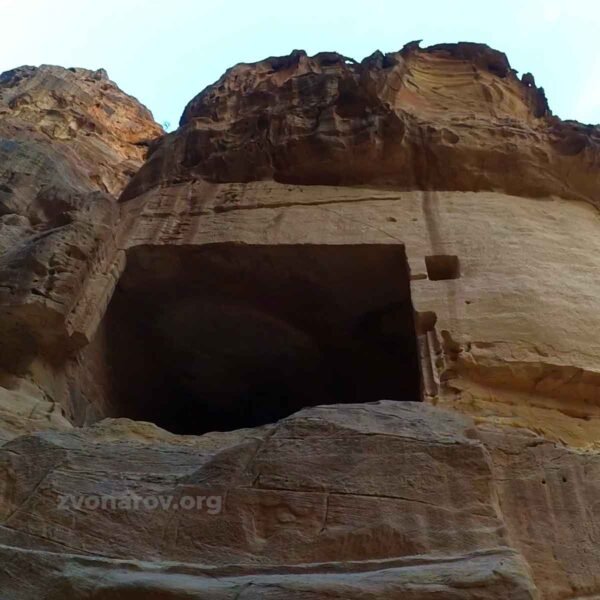
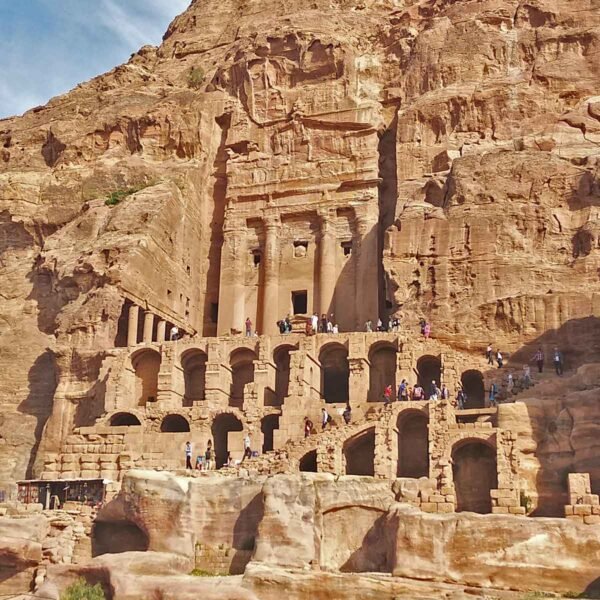
The Renaissance Tomb in Petra is another monument carved directly into the rock, as if its creation required no extraordinary effort. The first striking feature is that the side walls, both left and right, appear to have been cut down along their entire height to level the facade, upon which decorative reliefs were later added. The whole structure is a single monolithic mass, not built from separate blocks. Even the interior, which is quite spacious, was carved from the same rock. It contains no windows, and its original function remains uncertain.
The facade itself is sculpted into the cliff and adorned with stylized pilasters, cornices, and pediments. Rising to a height of about 15 meters, it features an entrance leading into a small rectangular chamber, most likely intended for burials. All of this was achieved within solid rock, without the use of masonry blocks, making it an exceptional feat of engineering for its era.
Yet, on closer inspection, the facade raises more questions than answers. Its straight lines, perfect symmetry, and unusually smooth surfaces seem difficult to reconcile with the simple tools attributed to the Nabataeans of the 1st–2nd centuries AD. The stone does not appear to have been shaped by chiseling but rather as if excess layers were somehow removed — almost like working with a softened material instead of hard sandstone. This remains the core mystery: what stands before us is not merely a tomb, but a possible trace of a technology that challenges conventional historical explanations.







There are no comments yet.