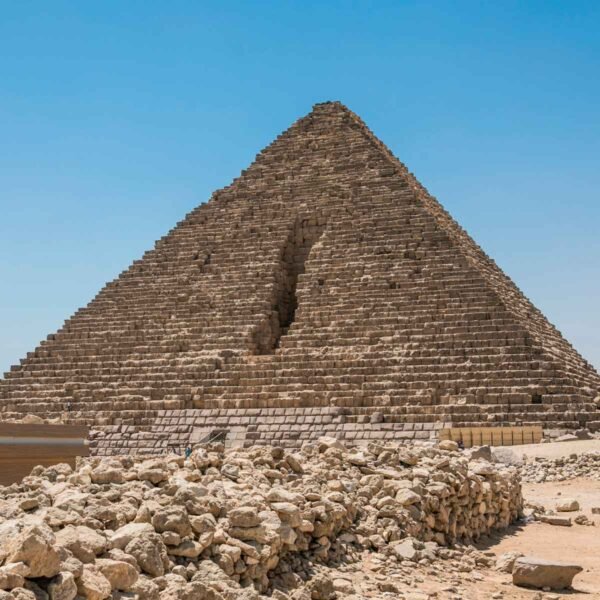
Pyramid of Khafre
The Pyramid of Khafre rises majestically on the Giza plateau, standing out with its preserved limestone casing. This ancient monument reveals the grandeur of royal power and continues to attract explorers with its unanswered mysteries. The pyramid of khafre remains one of the most iconic landmarks of Egypt, combining history, architectural skill and enigmatic charm.
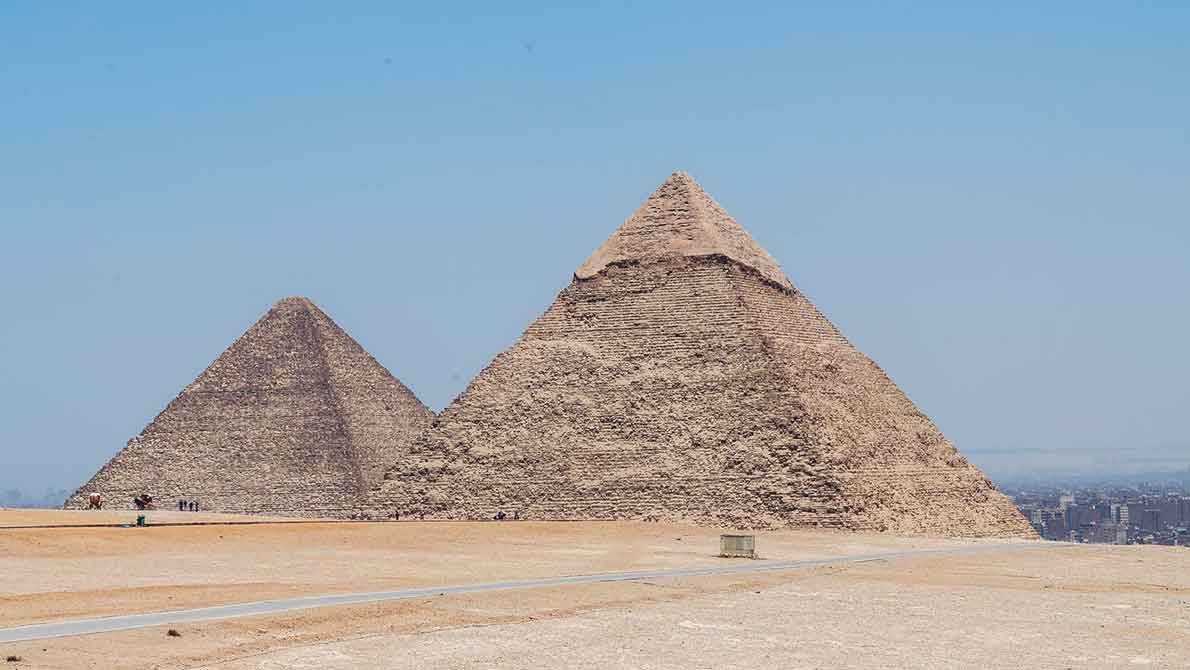
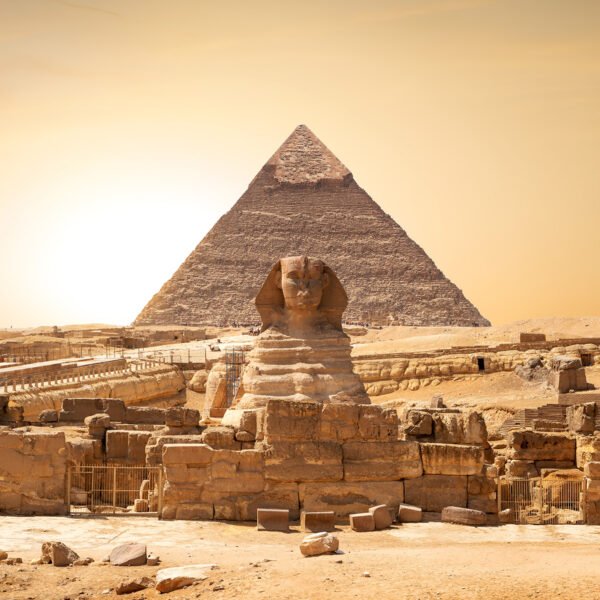
On the Giza Plateau, a few kilometers from Cairo, rises the second largest pyramid of Egypt — the Pyramid of Khafre. Although it is slightly lower than the Great Pyramid of Khufu, its silhouette makes a more impressive impression thanks to its advantageous location on an elevation and the preserved casing on the top. The original height of the structure was about 144 meters, and the base is close to a square with sides of 215 meters. This pyramid often becomes the main subject of photographs of the Giza Plateau and is considered the most harmonious in proportions.
Historians attribute the construction of the pyramid to the middle of the third millennium BC, linking it with the name of Pharaoh Khafre, son of Khufu. According to Egyptologists, the structure was erected as a royal tomb and included a complex of temples and roads connecting the pyramid with the Nile Valley. The internal rooms are relatively simple: two descending corridors and several chambers, the most famous of which is the so-called king’s chamber with a granite sarcophagus. The pharaoh’s body was not found in the pyramid, which is explained by ancient looting. In the 19th century, statues of Khafre made of diorite were discovered here, which strengthened the traditional association of the monument with this ruler.
Supporters of non-traditional views consider the Pyramid of Khafre not a tomb but a technical structure. Some see in it the remains of a highly developed civilization capable of processing granite and moving multi-ton blocks with precision unattainable for the Chalcolithic era. Others suggest that the pyramid served as an energy center that concentrated the natural forces of the Earth. They point to the presence of traces of sea salt deep inside, linking this with ancient catastrophes or floods, as well as to complex structural elements that, in their opinion, are redundant for an ordinary tomb.

Some researchers of the 20th century, including physicists, tried to approach the mystery of the pyramid from a scientific point of view. In the 1960s, scanning with cosmic particles was carried out, which did not reveal large hidden cavities but confirmed the high density and accuracy of the masonry. Modern independent authors consider the pyramid as a device for concentrating electromagnetic waves or infrasound. According to these versions, the shape of the structure and the dimensions of the chambers provided resonance effects, and the granite elements could have acted as conductors or resonators of energy.
Inside the pyramid, a granite sarcophagus has been preserved, embedded in the floor of the chamber. Its lid is arranged so that it is practically impossible to open it without destroying the construction. This gave rise to versions of a complex technical purpose of the sarcophagus. During excavations in the 19th century, researchers discovered remains of resin and traces of mechanical stone processing resembling the work of disk saws. The preserved casing blocks of white limestone at the top demonstrate an extraordinary precision of fitting. The external form of the pyramid is aligned with minimal deviations from the north–south axis, which indicates deep knowledge of geometry. Modern technologies such as muon tomography have not yet revealed new chambers inside the pyramid, but research continues.
The Pyramid of Khafre remains a mystery, combining the beauty of proportions with the enigma of its purpose. For some it is the tomb of a pharaoh, for others — a symbol of a vanished advanced civilization or evidence of ancient engineering experiments. Despite centuries of study, its secrets have not been fully revealed. And this is what makes the Pyramid of Khafre one of the most mysterious monuments of humanity, attracting the attention of scientists, travelers and dreamers from all over the world.

There are no comments yet.