Pyramid of Menkaure
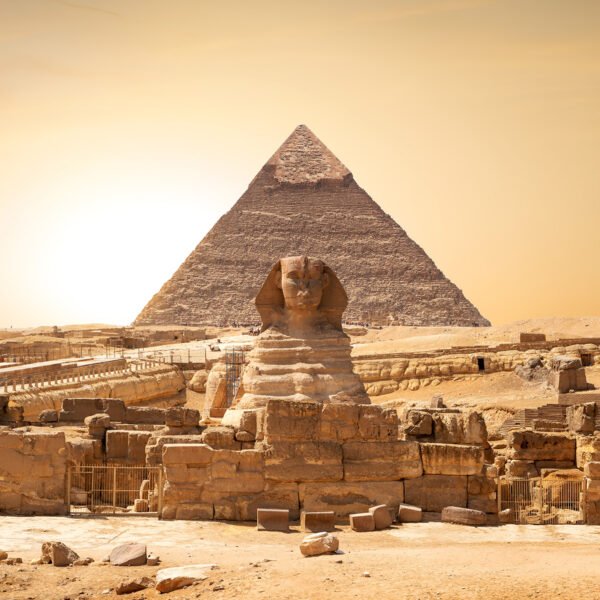
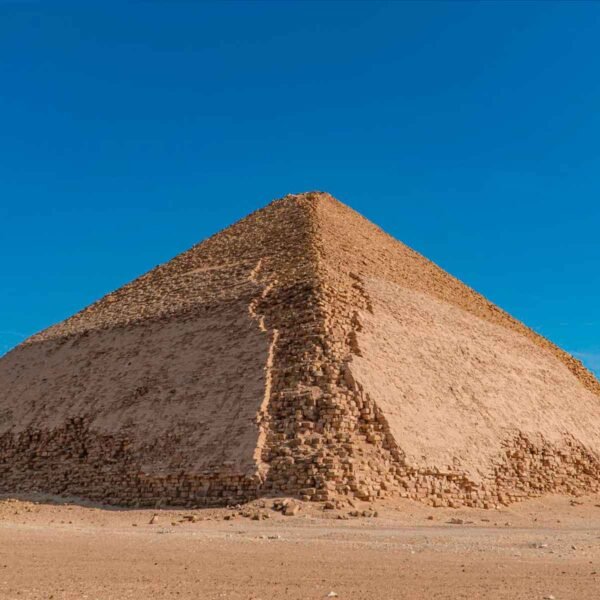
The pyramid of Menkaure rises on the Giza Plateau, completing the famous trio alongside Khufu and Khafre. Smaller in scale yet rich in symbolism, it captivates with its massive granite blocks and intricate design. Known also as the stepped pyramid of Menkaure, it reflects both power and mystery. Its story continues to fascinate visitors, making it one of the most enigmatic monuments in Egypt.
On the Giza Plateau, next to the grand pyramids of Khufu and Khafre, stands the third largest but no less mysterious pyramid — the tomb of Pharaoh Menkaure. Despite its comparatively modest size — about 65 meters in height and a base length of 108 meters — it is distinguished by unique features. Its lower rows were clad with massive blocks of red granite, which sets it apart from neighboring structures traditionally covered with limestone. This granite cladding gave the pyramid a special monumentality and symbolic strength.
According to Egyptologists, the pyramid was built in the middle of the third millennium BC, during the Fourth Dynasty. It was intended as the tomb of Pharaoh Menkaure, son of Khafre. Archaeologists point out characteristic features: a descending corridor cut into the rock leading to the burial chamber, covered with massive granite blocks. The interior chambers demonstrate the skill of ancient engineers: vaulted ceilings, carefully fitted stones, and signs of strict planning. The pyramid was part of a complex with temples and smaller satellite pyramids intended for queens.
Supporters of esoteric and non-traditional theories see the Pyramid of Menkaure not only as a tomb but also as a structure with a deeper purpose. Some see in the granite cladding and polygonal masonry traces of lost technologies. On the surfaces of the blocks are unusual processing marks resembling indentations or bulges, as if the stone was softened by an unknown method. Similar traces are found in Peru, which raises assumptions about the existence of an ancient global civilization with unified building techniques. Attention is also drawn to the eight-sided shape of the pyramid’s faces, similar to the Great Pyramid of Khufu, though on a smaller scale.

Some researchers believe that the pyramid was built in several stages, and part of the elements could have been completed or altered after Menkaure’s death. Inside, discrepancies are noticeable: perfectly aligned corridors coexist with roughly hewn rooms. This indicates possible intervention in later periods. Another hypothesis suggests that the granite cladding was not completed due to the pharaoh’s death or political changes. According to this version, the unique choice of material is explained not only by the symbolism of strength but also by the desire to distinguish the pyramid from its predecessors.
The Pyramid of Menkaure has been repeatedly subjected to destruction. In the Middle Ages it was attempted to be dismantled down to its foundation in search of treasures, but even after years of effort this proved impossible. Today, the surviving rows of granite cladding demonstrate the rare craftsmanship of stonemasons. Modern scanning methods have shown anomalies in the structure, suggesting the existence of hidden chambers. The use of polygonal masonry at the base is also of interest, reminiscent of megalithic structures in other parts of the world. All this makes the Pyramid of Menkaure an object not only of archaeological but also of interdisciplinary study.
Although the Pyramid of Menkaure is smaller in size than its famous neighbors, it remains a mystery that combines the skill of ancient architects, traces of lost technologies, and a subject of heated debate among researchers. Some see in it a traditional pharaoh’s tomb, others — evidence of a different civilizational logic. In any case, this monument rightfully holds its place among the great landmarks of world history, preserving the secrets of the past.

There are no comments yet.