Sphinx Great
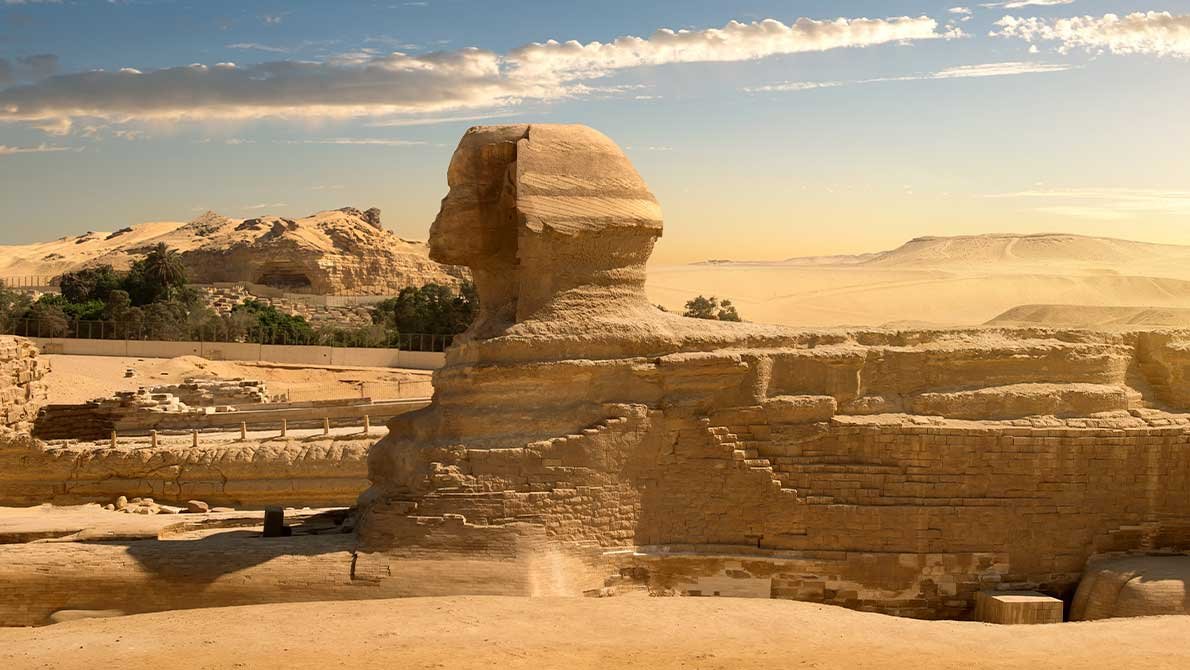
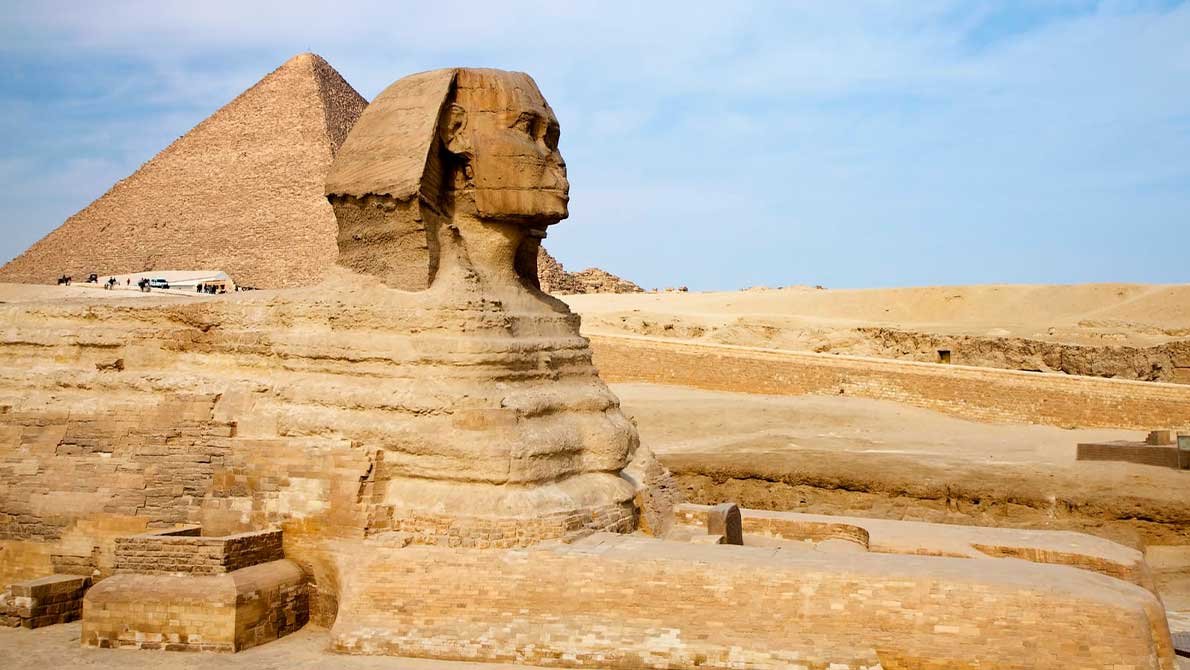
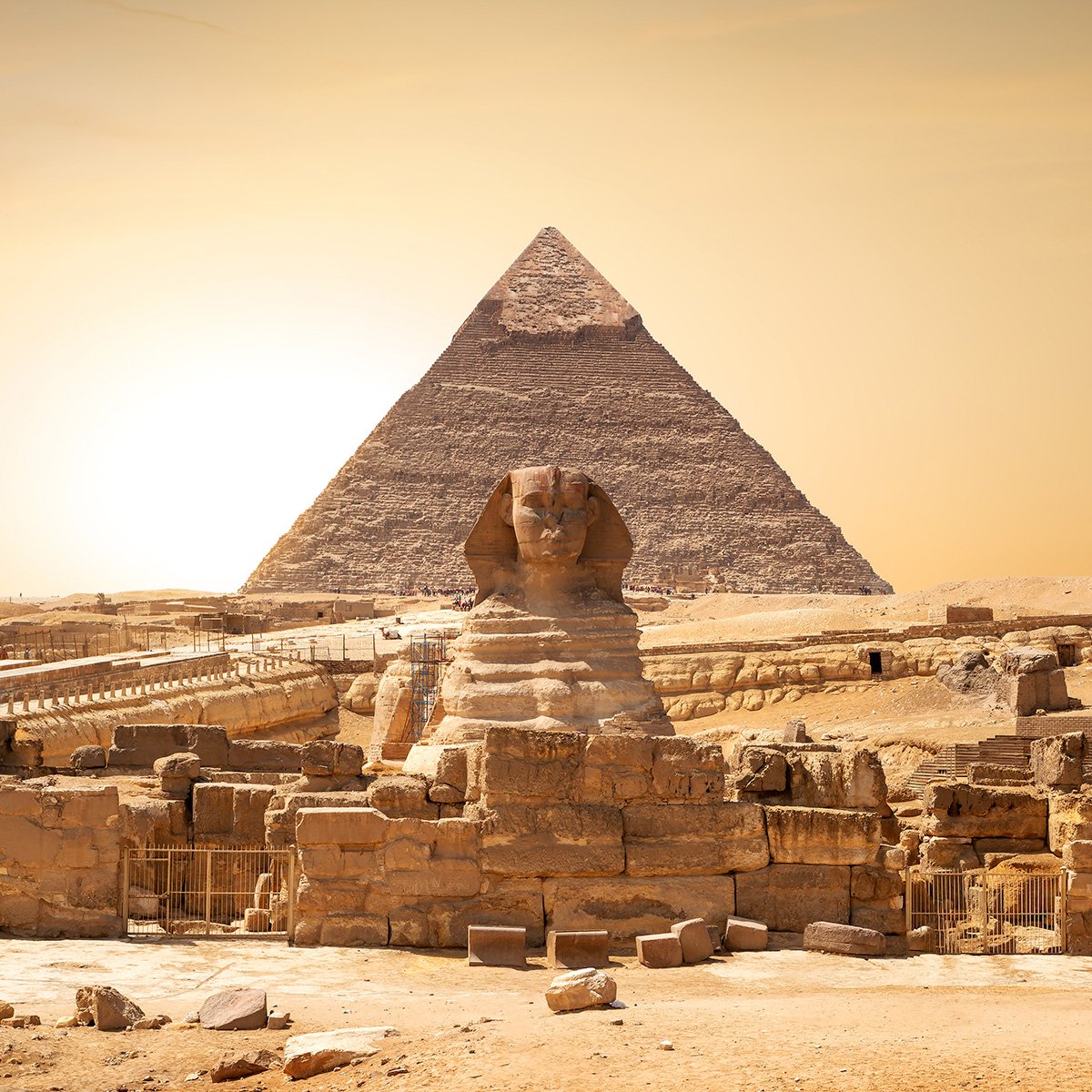
The Sphinx Egypt remains one of the most enigmatic monuments of the Giza Plateau, combining monumental scale with precise ancient craftsmanship. Its form and symbolism continue to inspire debates about its true purpose and deeper Sphinx meaning. The monument faces the pyramids along a carefully aligned axis, strengthening its connection to sacred landscape geometry. Within Egyptian mythology it also relates to solar symbolism and protective functions, making Sphinx pyramid surroundings even more significant.
The Sphinx, standing beside the Great Pyramids, remains an endless source of debate and disagreement among researchers. Some argue that the erosion patterns on its surface indicate that the region once experienced far heavier rainfall in deep antiquity. Others believe the Sphinx is a legacy of an advanced civilization whose technologies surpass the limits of official history. Still others are convinced that immense treasures are hidden beneath the monument, sealed off intentionally from historians and archaeologists.
Today, exploring these cavities is impossible, yet their existence is beyond doubt. Moreover, a vast network of chambers has been identified beneath the entire Giza Plateau, but access to them remains closed to researchers — let alone tourists. The few entrances that do exist are guarded by armed personnel and blocked with heavy metal grates, making entry nearly unattainable. What is being concealed? Why is the world prevented from studying such a unique piece of cultural heritage?
Photo: Francis Frith, 1858.
Returning to the Sphinx itself: in my opinion, its greatest mystery is that it was once completely buried beneath the sand. In fact, it was excavated relatively recently. What happened here? Why were ancient cities and structures in this region engulfed by sand to their very tops? The same phenomenon applies to many monuments throughout the Nile Valley.
If we stop viewing the Sphinx as a static symbol of the desert and instead see it as an engineered structure, it becomes clear that its creation required extraordinary precision. The monument measures roughly 73 meters in length, around 20 meters in height, and about 19 meters in body width. It is carved directly into the bedrock limestone, whose quality varies significantly across different sections: the lower layers are denser, while the upper ones are more fragile — which explains the uneven degree of weathering on its surface.
Far less discussed is the fact that traces of complex construction logistics still surround the Sphinx. Within the quarry where it sits, archaeologists have identified technological terraces, marks of ancient stone-cutting, and areas that may have served as platforms for lifting blocks. Several researchers also point to the monument’s geometric alignment with surrounding structures: the Sphinx faces almost perfectly along the east–west astronomical axis, with a deviation of less than 0.5° — an exceptional feat of accuracy for ancient builders.
Equally intriguing is the question of its reconstruction phases. Surface studies show that the Sphinx’s face was restored multiple times. Stone analysis reveals that some of its casing was fashioned in the pre-dynastic period and later replaced in subsequent eras. This suggests that the monument held significance not only at the time of its creation but for millennia afterward, as rulers of different ages sought to revive its appearance.
Another field of inquiry focuses on the acoustic properties of the Sphinx enclosure. Sound behaves there in unusual ways: low frequencies resonate more strongly than one would expect in an open environment. Some archaeoacoustics researchers propose that the pit’s shape may have been intentionally designed to amplify sound, creating a ritual “rumbling echo presence” — a quality valued in ancient ceremonial complexes.
There are also rare but intriguing findings related to the stone’s microstructure. Samples taken from various parts of the Sphinx show differences in limestone cementation. This has led to the idea that ancient builders intentionally left the statue as a monolith within the excavation rather than constructing it from transported blocks, as the density of the lower layers ensured a far longer lifespan. From an engineering perspective, this would have been a logical and deliberate choice, reflecting a high level of planning.
Despite the many mysteries, the official Egyptological position remains fairly clear. According to the traditional view, the Sphinx represents a lion-king figure associated with the solar cult. Its role is interpreted as protective: it served as a guardian of the horizon, an embodiment of pharaonic power, and a symbol of the ruler’s bond with the deity Ra-Horekhte. In Egyptian mythology, the combination of a human head and the body of a lion signified strength, dominion, and cosmic order.

There are no comments yet.