Temple of Hathor Stairs

The granite staircase of the Temple of Hathor in Dendera is one of the site’s greatest enigmas. Unlike the rest of the temple, built mostly of sandstone, these stairs were carved from a single massive block of granite. Their surface appears melted or eroded, defying logical explanation and challenging our understanding of ancient engineering. Visitors and researchers alike are left wondering — how was this masterpiece created?
Categories: ,
Overview

In this video, I am climbing the stairs of the Temple of Hathor, located in Dendera, near the city of Qena in Upper Egypt. This place is remarkable because, unlike the rest of the temple, it was built of granite. Most of the structure is made of sandstone, but this particular staircase is carved from granite. And it has two features that go far beyond what the official version of history can explain.

The first peculiarity lies in the fact that the staircase was carved from a single solid block of granite. Can you imagine how labor-intensive such a process would be? Why would anyone create a staircase from one massive granite block? It could have been made from ordinary sandstone pieces — but no. The ancient builders somehow chose to undertake this titanic task, one that even today would be considered monumental.

Modern craftsmen would not be able to create such a staircase from a single block. If you ordered something similar today, you would be offered a construction made from several smaller pieces, because extracting and shaping a monolithic piece of granite is an incredibly complex and costly endeavor. Yet for the ancient builders, this seemed to pose no problem — they completed the work flawlessly, bringing the granite staircase all the way to the top.

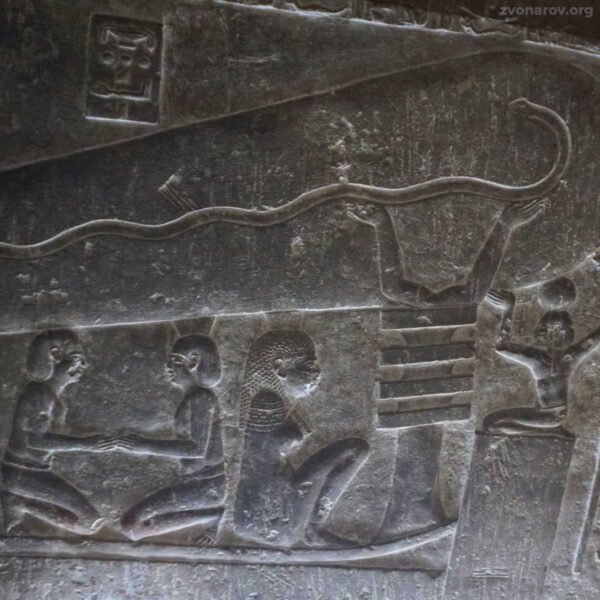
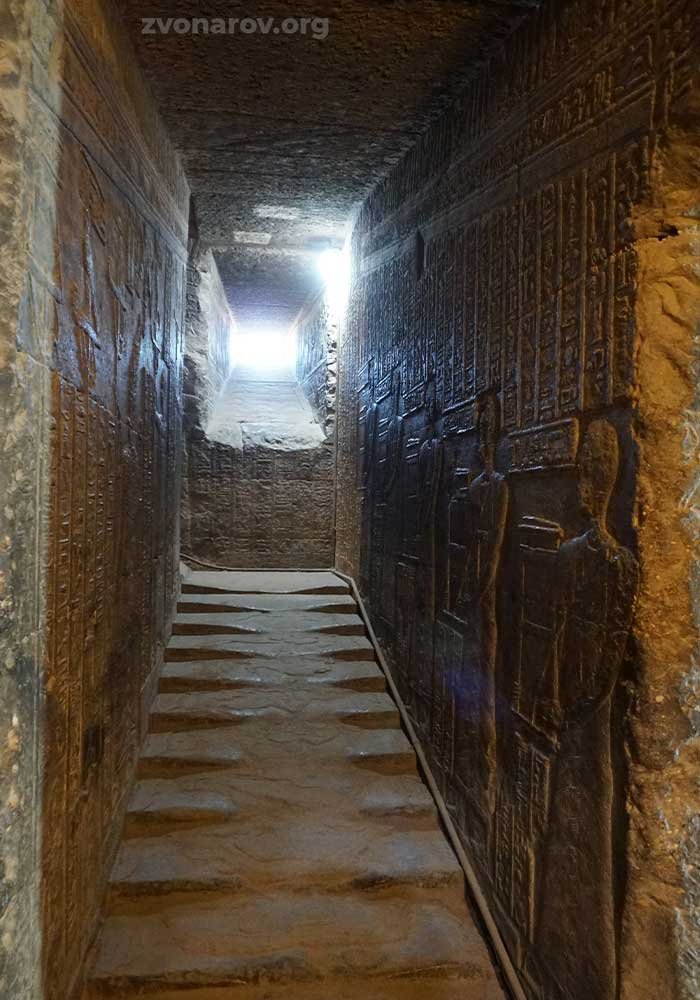
Corridor with ancient reliefs inside the staircase of Hathor Temple

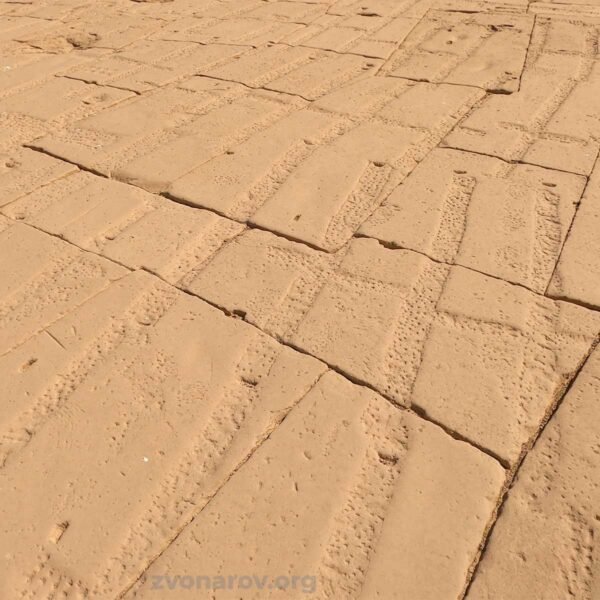
The second peculiarity, and one of the many mysteries of the Temple of Hathor, is that the staircase looks as if it has been worn down, eroded, or even melted. And that is truly strange, since granite is a material comparable in hardness to steel. To scratch granite requires tremendous force, and to grind it down to the condition we see in this video is virtually impossible.

Even if someone had been sliding down it for millennia on a metal pan, they could not have produced such marks. How was this effect created? In what period? And by what means could such a result have been achieved? The question remains open. There are numerous hypotheses and theories, but none of them have yet been backed by solid evidence.

What makes the Temple of Hathor stairs in Dendera so unique?
The Temple of Hathor stairs are exceptional because they are carved from a single block of granite, while most of the temple is made of sandstone. Creating such a staircase from one solid granite piece would require tremendous precision and effort, even with modern tools. This design choice remains one of the most intriguing architectural mysteries of Dendera.
Why were the Temple of Hathor steps made of granite instead of sandstone?
Granite is far harder than sandstone and extremely difficult to quarry and shape. Yet, the builders of the Temple of Hathor chose to use it for the main staircase, possibly to ensure durability or symbolic strength. The decision to carve the stairs from one massive granite block shows an advanced level of craftsmanship and purpose that still amazes modern researchers.
Why do the Temple of Hathor stairs appear melted or eroded?
The granite steps show smooth, rounded surfaces that look as if they were melted or softened. Since granite is nearly as hard as steel, natural erosion or human traffic cannot explain such a level of wear. Some theories suggest ancient heat exposure, lost technology, or an unknown natural process that altered the granite surface without destroying the structure itself.
What are the main theories about how the Temple of Hathor stairs were built?
Several theories exist: some propose advanced stone-working methods involving extreme heat or vibration tools, while others believe the staircase was inherited from an earlier civilization and reused in the current temple. Conventional Egyptology explains it as a product of exceptional manual skill, but the precision and unusual material continue to spark debate among alternative history researchers.
What is the symbolic meaning of the Dendera staircase in Egyptian culture?
In ancient Egyptian temples, staircases often symbolized ascension — a ritual passage between the earthly and the divine. The Dendera staircase may have been used in sacred processions leading priests to the rooftop to greet the rising sun. Its granite composition could represent endurance and spiritual permanence, aligning with Hathor’s role as a goddess of life, light, and rebirth.
Can visitors see and climb the Temple of Hathor stairs today?
Yes, visitors to the Temple of Hathor in Dendera can still observe and sometimes climb the granite staircase under supervision. The steps are polished and can be slippery, so caution is advised. Guides often highlight the strange “melted” texture and explain both the traditional and alternative theories surrounding this mysterious feature.
Where is the Temple of Hathor located, and how can travelers visit it?
The Temple of Hathor is located in Dendera, near Qena in Upper Egypt, about 60 kilometers north of Luxor. Travelers can reach it by car or guided tours from Luxor. The site is open to the public and is considered one of the best-preserved temples in Egypt, offering a rare look at ancient architecture, the Dendera Zodiac, and the enigmatic granite staircase.
Comments

There are no comments yet.

Be the first to comment “Temple of Hathor Stairs”

Your email address will not be published. Required fields are marked *